
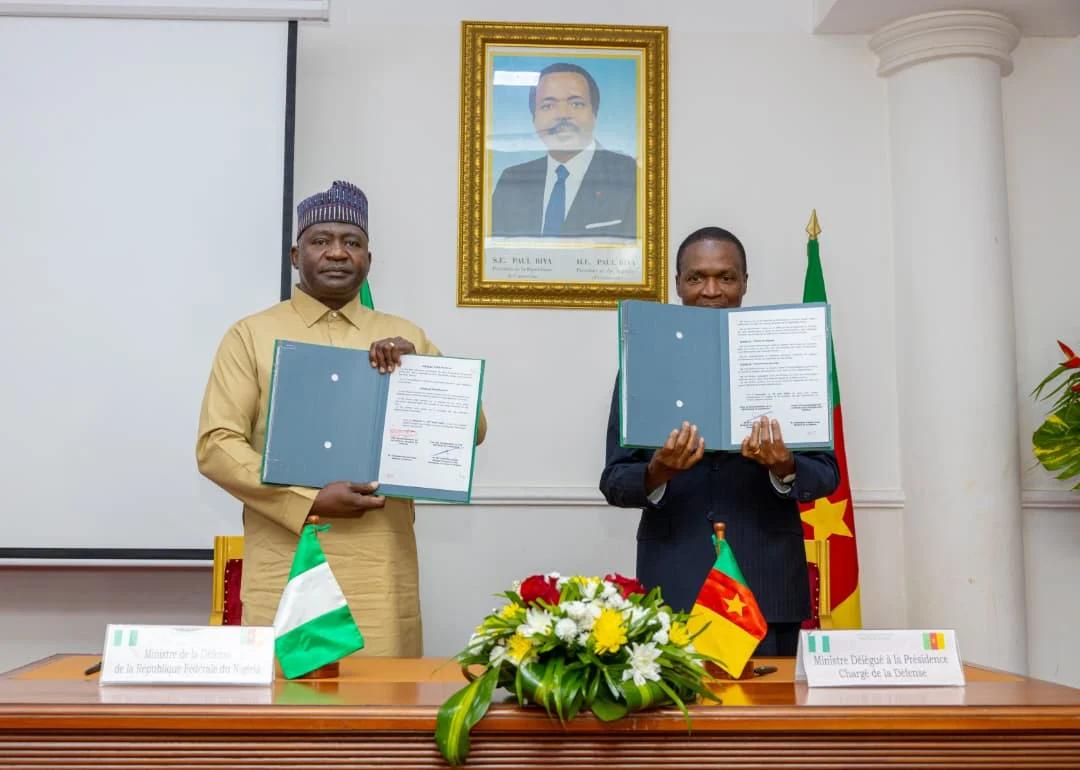
Nigeria, Cameroon Deepen Security Partnership With New Border Defence Agreement
Nigeria and Cameroon have strengthened their security relationship after both countries formalised a new defence cooperation agreement aimed at improving border protection and responding to emerging regional threats.
Reports indicated that officials from both nations signed a Memorandum of Understanding following strategic engagements between defence representatives in Yaoundé. However, what we found out is that the agreement goes beyond border surveillance and introduces broader cooperation covering intelligence, military coordination and maritime security.
According to details released after the meeting, the new arrangement is expected to create a structured framework for joint security operations across land and coastal areas shared by both countries.
Authorities explained that the partnership is designed to strengthen existing cooperation while adapting to changing security realities in the region.
The agreement reportedly covers several operational areas including intelligence exchange, coordinated military activities, logistics cooperation, training opportunities and personnel development initiatives.
Officials also highlighted mechanisms intended to improve collective responses to security threats affecting both countries.
Speaking after the signing, Nigeria’s defence leadership described the agreement as an important step toward institutionalising military collaboration and creating stronger coordination channels between both nations.
According to officials, the framework is expected to support long-term cooperation in addressing cross-border challenges and protecting strategic national interests.
Maritime security also featured prominently during discussions between both countries.
Attention was directed toward expanding efforts in the Gulf of Guinea, an area considered strategically important for regional trade, energy resources and international shipping activities.
Officials noted that stronger collaboration at sea could improve security outcomes and support economic stability across the region.
Part of the discussions also focused on activating joint operational structures intended to improve maritime monitoring and response capacity.
Beyond operational security, both countries explored opportunities in defence industry development.
Officials acknowledged that many African nations continue to face challenges linked to dependence on imported military equipment and limited local production capacity.
Nigeria’s representatives emphasised the importance of building stronger regional capabilities through industrial partnerships, local manufacturing, technology exchange and collaborative innovation.
Cameroon’s defence officials also expressed interest in expanding cooperation beyond traditional military operations and indicated that discussions were progressing toward more formal arrangements in defence technology development.
The agreement comes at a period when conversations around border management and regional security cooperation remain active across West and Central Africa.
Recent concerns over cross-border movements and security incidents have increased calls for stronger coordination between neighbouring countries.
Observers note that defence partnerships of this nature are increasingly viewed as important tools for addressing complex threats that extend beyond national boundaries.
As implementation begins, both governments say the objective remains improving stability, protecting sovereignty and strengthening regional cooperation for long-term peace and security.